
Designing Problem-Solving Frameworks
Business frameworks don't solve problems, teams do. Using Spiral Dynamics, designers can begin to evolve existing frameworks, like the Three Horizons Model, and teach the problem-solving mindsets behind them.
As a designer, I’m totally mystified by the “framework explosion” of magical boxes and lines littering the internet and business books. These canvases, maps or models are illustrated beautifully in a way to help others inherit the mindset of their creators deeply buried in artful diagrammatic masterpieces. We often put sticky notes one by one upon them, iterating towards a visual synthesis of complex thinking.
Here are a few popular frameworks I’ve used in the past. Take a look at McKinsey's Three Horizons Model or Deloitte’s Strategic Choice Cascade. The internet is littered with product and strategy frameworks, often branded by an agency with a monetization plan behind it. The typical design process goes like this:
- Come up with a framework to solve a problem
- Make it super simple (and pretty)
- Build a white paper around it
- Then, sell how to use it
- Rinse and repeat
After speaking to the people left with frameworks hanging on large laminated posters as 21st-century innovation artwork, I’ve learned one important thing.
Frameworks don’t solve problems. Consultants teach people how to use frameworks. In reality, teams of people solve problems. As a designer, I want to teach team's the mindset behind the framework.
What is Spiral Dynamics, and how does it help us solve problems?
In the 1950’s, Clare W. Graves, PhD, developed a framework for human and organizational development. Based on research done with his students while teaching in New York, he postulated that the mature form of a human being, or an organization, followed an emergent cyclical path, or spiral. And, as people traversed the spiral upward or downward, their brains unlocked new “neurobiological tools” to solve problems in a quest to exist in the world.
Through his research, Graves found that, with growth, a deeper capacity for problem-solving emerged—one less rigid and compulsive in its orientation. This abundant problem-solving capacity emerged in various states. From a state of multiplicity (solving problems in different ways), to a state of relativism (solving problems with shared resources), to a state of systemic orientation (solving problems in a collective way).
How can Spiral Dynamics help us design better frameworks?
Buried in the boxes and lines of the frameworks we use today is a problem-solving capacity, a spiral mindset about the world, that shapes how we orient to a problem.
With your favorite framework or tool in mind, consider:
- How does it help you or your team solve problems?
- Does it help orient to one of the following problem-solving mindsets?
- A sense of what’s right or wrong
- A way to maximize resources
- A way to orient to higher impact
- Or, a way to connect the dots with other systems
Within each framework lies the possibility for evolution to an increasingly higher perspective and problem-solving orientation. Selling frameworks keeps people stuck. Teaching frameworks keeps people stuck. Teaching the mindset gives freedom to challenge the status quo, to challenge the framework and to redesign the framework in a way that unlocks greater problem-solving capacity.
Let’s rethink how we design and teach frameworks through an example.
Take a look again at McKinsey's Three Horizons Model. They’ve got a great video on their website describing the original mindset that fueled its creation in 1999. The framework began with the core problem of where to allocate cash now for the future. At the time, corporate divisions had individualized growth plans, and more rigor was needed to describe where investment was needed at a governance level across time horizons. Considerations for investment included market attractiveness and the competitive position across three time periods, H1, H2, and H3. These horizons can be defined as follows:
- H1s: growth improvements in existing markets
- H2s: growth ideas to extend the business into emerging markets
- H3s: disruptive growth ventures into brand new markets
Moreover, you can also think of these horizons as the ambition of growth. A higher investment in H1s can be seen as more passive, resting on the existing competitive position and revenue.
More investment in H2s can be seen as more assertive in using the existing competitive position to extend the business. H3s are aggressive, disrupting the current business by developing a new position in a new market, driving bigger revenue.
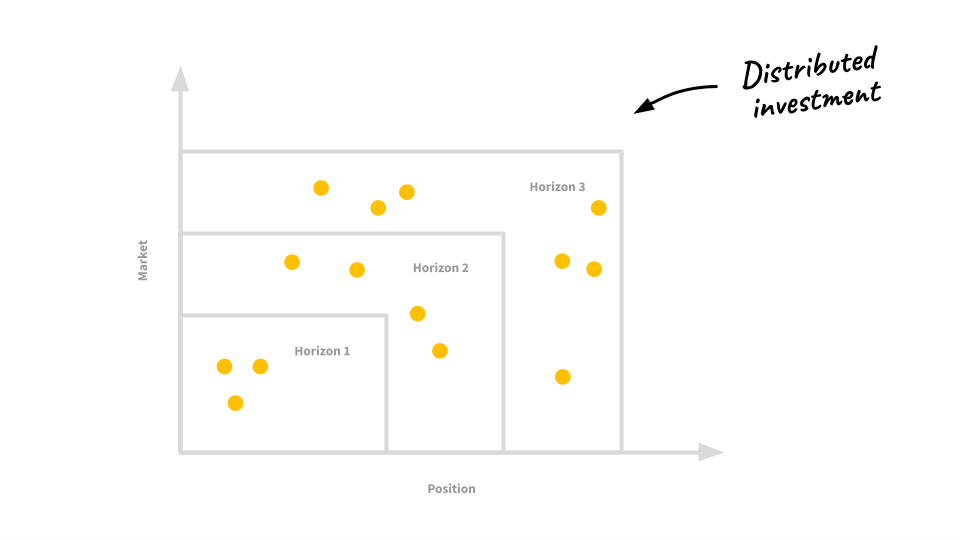
Here’s what the three horizons look like visually. The mindset behind this framework is highly valuable. It’s a way of thinking that generates financial abundance and advances the science of resource allocation across a risk-adjusted time horizon. It’s an inward, assertive view of the organization about how it and it alone plans to grow.
Now, let’s rip it apart and rebuild it based on an evolving problem-solving perspective.
Problem #1: Change is happening faster and learning is a more valuable input
First, what if we thought about the horizons not as places to invest to make money? Instead, imagine them as lily pads of learning, with each idea a place to learn. What if we viewed the map as an integrated set of learning opportunities—an H1 learning connected to an H2, connected to an H3? And within that string of learning, a new strategic intelligence towards a vision.
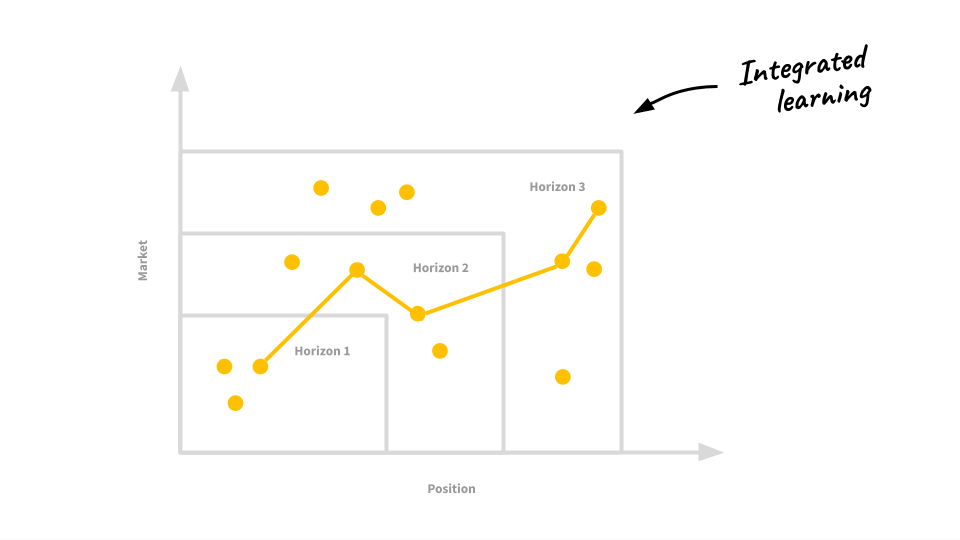
Here’s another view of the map, with a string connecting five opportunities. Where is the best place to start learning? The x and y axis have stayed the same, with opportunities evaluated based on survival against our competitive position and how we can expand in the market.
Mindset: Shift from now, near OR far, to a tri-modal now, near, AND far consideration simultaneously
Micheal Brennan does a great job of explaining tri-zone leadership (reframed to tri-modal in this post).
Problem #2: Change is happening faster,in line and adaptation is the new normal
We used to believe we could do strategy and then execute separately. Within the strategy was the plan to adapt to either changing market conditions or to our position. However, what if we stopped thinking about adaptation as a way to grow our bottom line and instead as a way to grow and evolve within an ecosystem? Within an integrated learning path across H1s, H2s and H3s, the anticipated growth can be more passive, assertive, or aggressive—regardless of the investment allocations in each time horizon. This decoupling keeps us focused on the world outside and constantly evaluating the path’s growth ambition.
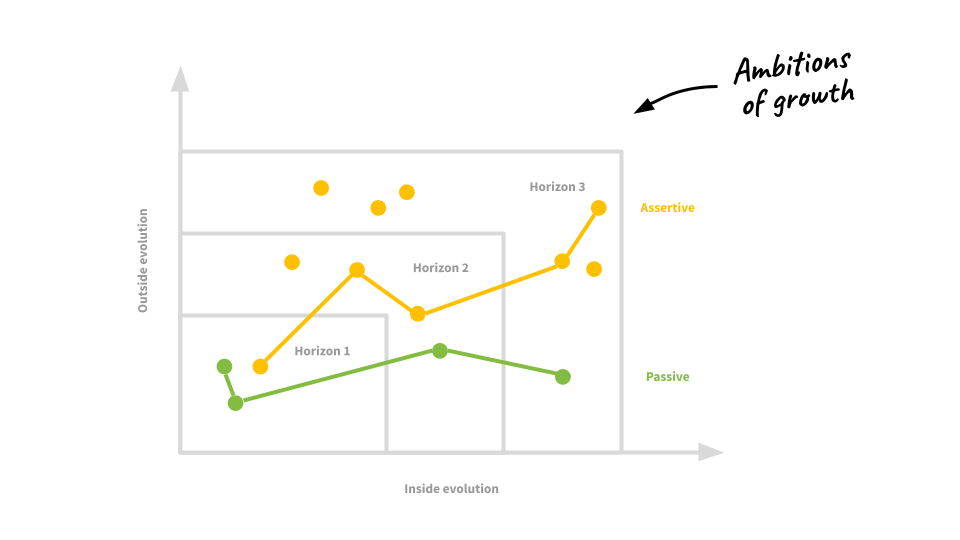
Here’s another view with two paths, one more assertive and one more passive. In the green path, we adapt to stay inline with the outside world. In the yellow path, we adapt in a way that also shapes the outside world. The ambition is not central to the horizons, but instead to the learning or growth path. You’ll notice the x and y axis have changed to be more about adaptation against the tension between the changes happening inside and how we fit in a changing world outside.
Mindset: Shift from inward knowing of how to enter a market to outward sensing of how the world is evolving.
Menno Dijk has a great explanation of sensing in unchartered territory. This mindset helps us identify an outward ambition:
- A more passive ambition: quickly following the ecosystem or industry evolution
- A more assertive ambition: shaping the ecosystem or industry’s future with others by assertively changing ourselves inside, in concert
- A more aggressive ambition: disrupting the ecosystem by leading the way in an opinionated view of the future; aggressively changing ourselves inside as a model to others
Problem #3: Change is happening faster, and interdependency accelerates learning
Often, we identify a growth path and begin to work independently, believing it’s our own bottom line that is most impacted. What if each growth path and our ambition were chosen based on the level of interdependency and collective orientation to the problem? And, what if we disrupted a shared industry capability instead of a market or a competitor? In this shift of the Three Horizons Model, we no longer consider independent ideas or a path to our vision. Instead, we consider a common zone where others are making changes to the status quo.
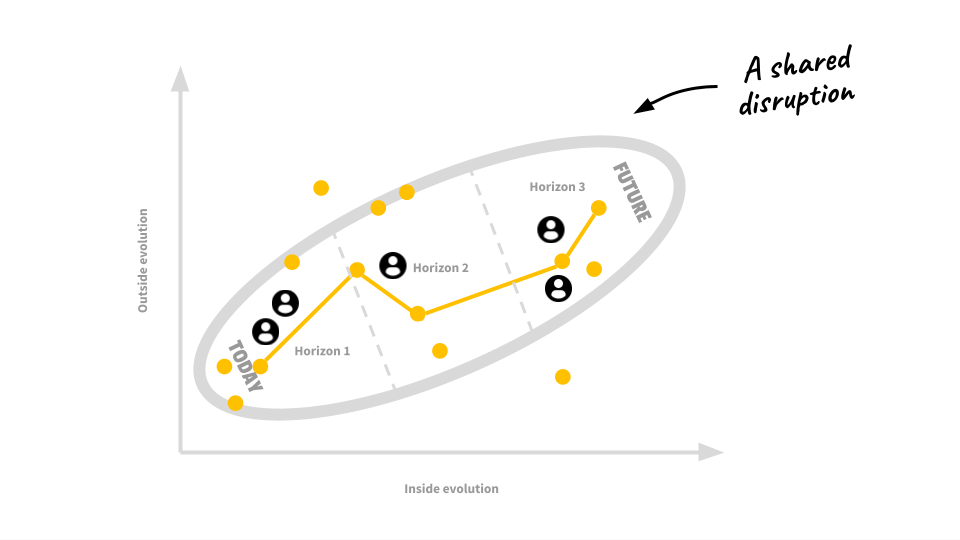
In the last adjustment, we create a football-shaped zone where we can focus our learning to disrupt the status quo. Within this zone, we begin to consider who we can collectively learn with to create a shared assertive growth path together.
Mindset: Shift from independent action to interdependent learning.
While often used in social platforms, this mindset can be best articulated in this post about collaborative innovation networks.
In conclusion, every framework is just boxes and lines, with a buried mindset hiding in plain sight.
It’s our responsibility as designers of systems of innovation to take a spiral approach. We must expose the underlying mindset, decide whether to shift it, then move those boxes and lines around a bit. In doing so, we expand the capacity of our organizations and strategies to respond to the real problems we’re facing.
What is a new problem you’re trying to solve? What framework are you using? And what is the shift in mindset you want to facilitate in the people using it?
Now, what does that new framework look and feel like?



Comments ()