North by Northeast
Health systems tend to fall into one of four organizational realities based on their relative strengths in strategy and execution.

A four-quadrant test for health system leaders to align strategic intent and execution
Health systems tend to fall into one of four organizational realities based on their relative strengths in strategy and execution.
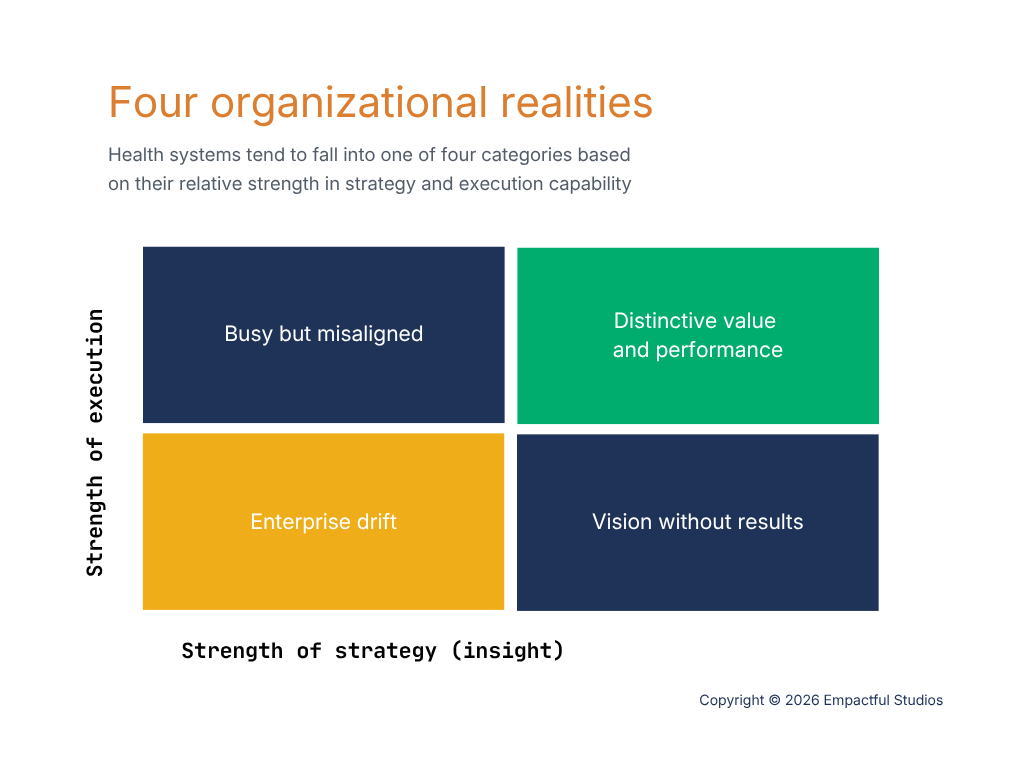
These four categories are based on my observations during the past 35+ years working in the health care sector. They can be characterized as follows:
Enterprise drift
Organizations with limited strategic clarity and weak execution capability tend to drift from one issue to the next. Performance is reactive. Leadership attention is consumed by near-term pressures such as staffing, access, and throughput without sustained forward progress.
These systems are not failing from lack of effort, but from lack of coherence and discipline.
Busy but misaligned
Some organizations have strong operational capability. They can execute but lack a clear strategic focus. These systems are often highly active, even productive, but misaligned with the issues that materially drive margin improvement, market share growth, and brand differentiation. Activity is high. Impact is uneven.
These are often systems with a strong hospital- or academic-based medicine chassis and deeply experienced operations teams, but with a smaller footprint in ambulatory and value-based care.
Vision without results
Other systems excel at strategy. They see the future clearly. Leadership meetings are insightful, aligned, and often inspiring. But without corresponding investment in execution capability, strategy remains aspirational. Frontline teams experience initiatives as layered complexity, and confidence in achieving results erodes over time.
These enterprises often have a strong and charismatic leader—and sometimes a distinctive economic moat, such as a very strong brand or sole-provider clinical status—that allows them to command good contracts without operational discipline.
Distinctive value and performance
The highest-performing organizations align both dimensions. They pair strategic insight with disciplined execution. They translate vision into redesigned workflows, aligned incentives, and measurable outcomes. These systems do not just plan well. They perform. And they create distinctive value in the market as a result.
These organizations do exist, and my observation is that many are mid-sized regional clinical enterprises with strongly balanced ambulatory and inpatient acute clinical business lines. Many have integrated population health and service lines to create disciplined operating platforms built around consumer journeys.
Moving North and East
Every leader should be focused on moving their enterprise into the upper right quadrant. That is where mission success and margin sustainability happen. It is where leadership legacies are made.
That journey requires that we stop seeing execution as downstream work that happens after the strategy is defined. In fact, execution is a capability that must be intentionally built with the same rigor as revenue cycle management, quality assurance, compliance, and marketing.
Success requires investment in two things that are frequently underdeveloped: