
The End of Big Money in Executive Search
Hospitals and health systems can no longer afford the legacy search model. And, making the hire is not the finish line. What to do instead.

Why hospitals and health systems can no longer afford the legacy search model — and what to do instead
The math your board should see
Say you're hiring a hospital CFO with a total annual compensation of $600,000. Under the traditional retained search model, you can expect to pay $180,000 to $195,000 — a 30% fee on anticipated first-year compensation, on top of administrative charges, marketing fees, and travel for the search partner to visit you.
Most of that money doesn't go to the person running your search. Search partners typically keep 35% to 55% of the fee; a partner running 10 searches a year can clear well over $1,000,000 annually. That income comes largely from hospitals and health systems operating on the thinnest margins in American business.
Median hospital operating margins closed 2025 at just 1.3%, according to Kaufman Hall's National Hospital Flash Report, with expenses rising, bad debt and charity care climbing, and payer mix shifting toward government payers. Roughly four in ten hospitals still operate in the red. Every dollar matters yet most organizations continue to pay legacy search fees as if margins were 10%.
The savings opportunity runs from $25,000 to more than $200,000 per search, at the Director level through the C-suite. Run several searches a year, and that adds up to $500,000 to $750,000 annually — enough to fund a service line investment, a retention program, or a capital project. It's worth asking why that money is leaving the building.
What you're actually paying for
Here's how a traditional retained search really works: the search partner is the face of the engagement, rarely the engine behind it. An associate writes the position overview. Another builds the posting. One or two more resumes to review and run initial screens. Only then does the search partner meet the candidates who made it through the funnel and present three to six they "feel good about" — usually without objective assessment data, validated benchmarks, or any real baseline for comparison.
For that, you pay 30% of the anticipated compensation, plus fees and expenses.
This pricing made sense when search firms held exclusive networks and information was scarce. That era is over. The pricing never caught up.
The demand for executive talent is rising — fast
This isn't a once-a-decade problem. Leadership turnover in healthcare is accelerating:
Hospital CEO departures rose 15% year over year through July 2025, according to Challenger, Gray & Christmas, with 78 exits in seven months, part of the highest CEO turnover environment since the firm began tracking in 2002.
One-third of new CEOs in the first half of 2025 were appointed on an interim basis, up from just 9% in each of the prior two years, a clear signal that boards are being caught without a plan.
Succession planning is the gap
Research from the Governance Institute has found that hospital boards are least likely to maintain a written succession plan for CEO and senior executive roles compared with their other oversight duties.
Turnover doesn't stop at the top. A CEO transition typically triggers additional executive departures within the first year. For a mid-size health system, three to five executive searches in a twelve-month window is not the exception, it's the pattern.
Under the legacy model, that pattern costs you $600,000 to $1,000,000 or more. It doesn't have to.
Making the hire is not the finish line
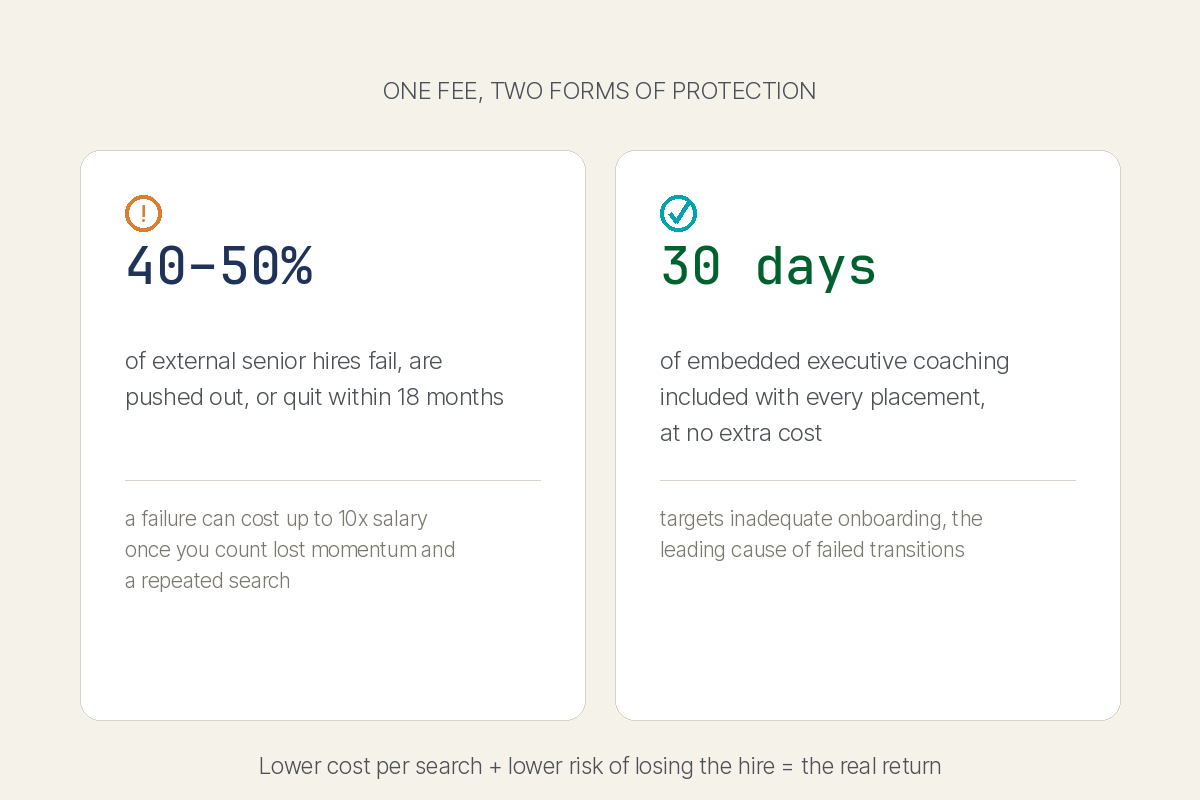
Here's what most retained search firms won't tell you: getting the right person into the role is only half the job. Between 40% and 50% of externally hired senior executives are pushed out, fail, or quit within 18 months, according to research from Heidrick & Struggles and the Corporate Executive Board.
The cost of that kind of failure can run up to ten times the executive's salary, once you count the lost momentum, the disengaged team left behind, and the search you now have to run all over again.
The reasons rarely come down to competence. They come down to integration — a new leader who doesn't yet know how decisions really get made, hasn't built trust with a team that's watching closely, and is left to read the organization's culture and politics on their own.
Inadequate onboarding is cited as a factor in roughly 45% of failed executive transitions. It's a preventable problem, and it's one that most search firms hand off the moment the offer letter is signed.
Coaching should not be a bolt-on or an afterthought. That’s why our model includes the same leader transition coaching methodology we already use with health system leaders navigating role changes, adapted for the highest-stakes month of a new executive's tenure. Our coaches work alongside new hires for the first 30 days to connect who they are with what their new role demands.
Pairing search with this kind of transition support directly targets the leading cause of failed executive hires, thus saving organizations additional turnover costs.
A different model: Retain a partner, not a fee structure
At Empactful Studios, our retained search partner model was designed specifically for this environment.
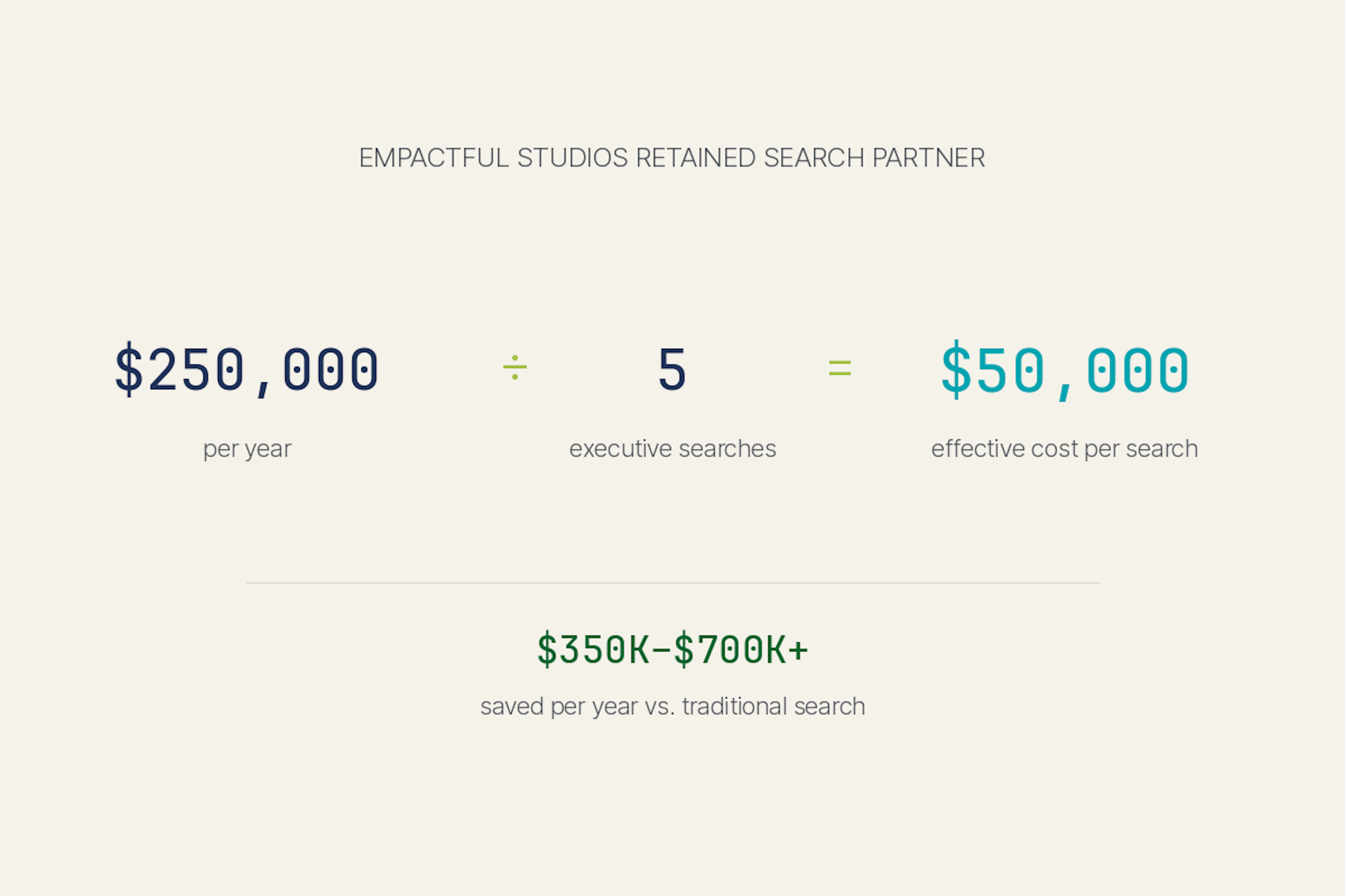
Our executive search retainer option includes five executive (VP through C-suite) searches per year, plus transition coaching for new hires in their first 30 days of employment. At $250,000 for the year, your cost per search is $50,000. Against traditional fees, that’s a savings of $350,000 to $700,000 or more per year. You get a dedicated partner who learns your culture, strategy, and leadership bench, rather than a new engagement team each time.
If this scale doesn’t fit your needs, you can use our single-search option with a fixed fee of 23% for VP-through-C-suite roles and 20% for Manager- and Director-level searches. No marketing surcharges or administrative fees on top.
Both models include the same concierge-level service and strong placement guarantees you'd expect from a top-tier firm, without the fee structure built to fund seven-figure partner incomes.
The clinical side of healthcare keeps changing. It's time the business side does too.
Your organization has transformed care delivery, embraced value-based models, and rebuilt operations under relentless financial pressure. Executive search is one of the last corners of healthcare still priced like it's 1995. Change it.
What will you do with $500,000 back in your budget and teams that are more integrated and engaged?
Sources: Kaufman Hall National Hospital Flash Report (2025 year-end data); Challenger, Gray & Christmas CEO turnover reports (2025); Governance Institute board practices research
Comments ()